DSS Pooling
This page provides background information on what pooling is and how it is accomplished. For pooling operational instructions, see deployment.
Introduction
The DSS is designed to be deployed in a federated manner where multiple organizations each host a DSS instance, and all of those instances interoperate. Specifically, if a change is made on one DSS instance, that change may be read from a different DSS instance. A set of interoperable DSS instances is called a "pool", and the purpose of this document is to describe how to form and maintain a DSS pool.
It is expected that there will be exactly one production DSS pool for any given DSS region, and that a DSS region will generally match aviation jurisdictional boundaries (usually national boundaries). A given DSS region (e.g., Switzerland) will likely have one pool for production operations, and an additional pool for partner qualification and testing (per, e.g., F3411-19 A2.6.2).
Terminology notes
Some databases establish a distributed data store called a "cluster". This cluster stores the DSS Airspace Representation (DAR) in multiple SQL databases within that cluster. This cluster is generally of many nodes of the database, potentially hosted by multiple organizations.
Kubernetes manages a set of services in a "cluster". This is an entirely different thing from the database cluster, and this type of cluster is what the deployment instructions refer to. A Kubernetes cluster contains one or more node pools: collections of machines available to run jobs. This node pool is an entirely different thing from a DSS pool.
Objective
A pool of InterUSS-compatible DSS instances is established when all of the following requirements are met:
- Each database node is addressable by every other database node
- Each database node is discoverable
- Each database node accepts the certificates of every other node
- The database cluster is initialized
These requirements are met differently depending on the data store used: - YugabyteDB - CockroachDB
Creating a new pool
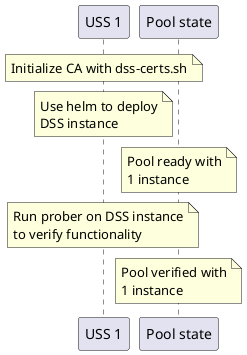
All DSS instances are equal peers, and any set of DSS instance can be chosen to create the pool initially. After the pool is established, additional DSS instance can join it. After that joining process is complete, it can be repeated any number of times to add additional DSS instances, though 7 is the maximum recommended number of DSS instances for performance reasons. The following diagram illustrates the pooling process for the first two instances:
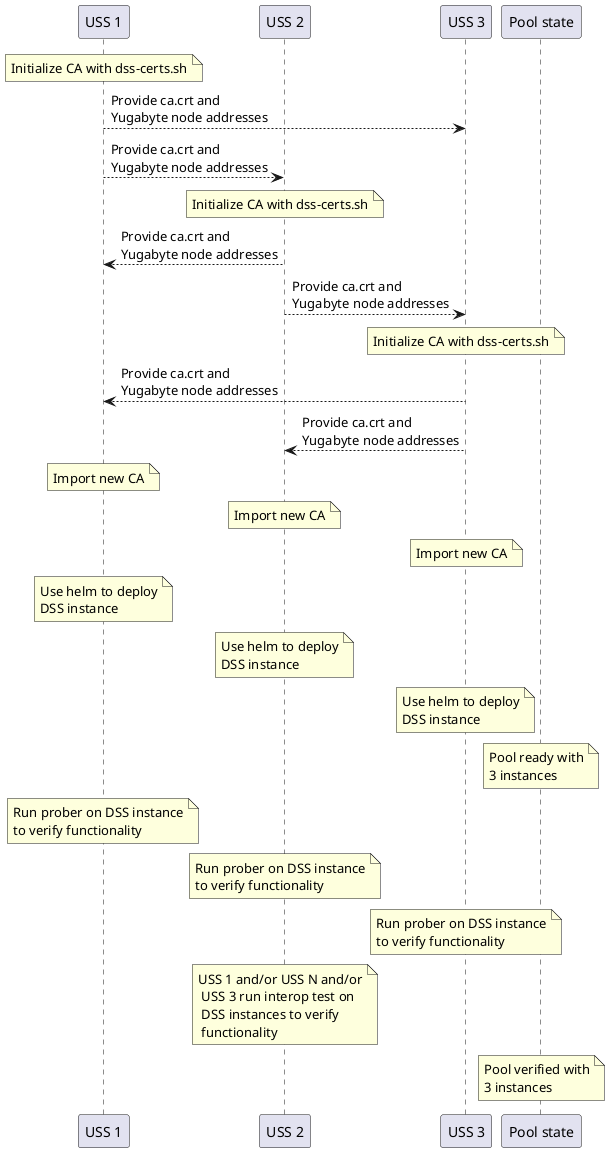
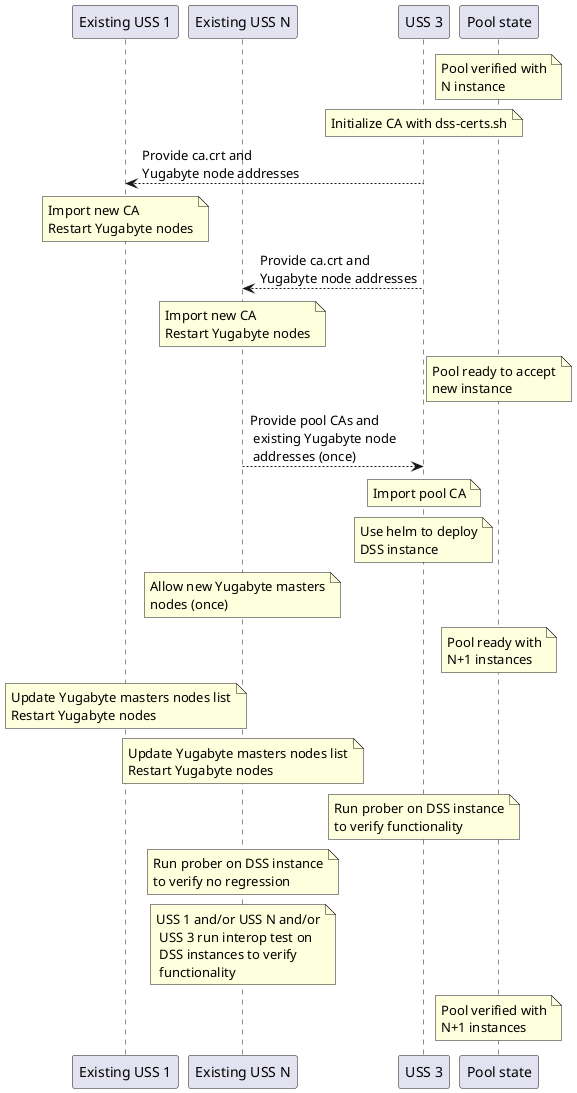
Adding participant is illustrated below. Some actions marked with (once) need
to be run only once by one participant otherwise all participants in the current
pool must ran then.
Establishing a pool with the first instance
The USSs owning the first DSS instances should follow the deployment instructions.
Joining an existing pool with new instance
A USS wishing to join an existing pool (of perhaps just one instance following the prior section) should follow the deployment instructions.